Assignment 1
History of Storyboards
Webb Smith from Disney was mainly credited, although some
sources state that George Melies was initially the first person to use
storyboards. Before they were known as ‘Storyboards’ they were comic strips and
served the same purpose, it was Smith who named them. The film ‘Gone With The
Wind’ was one of the first live action feature films to be shot with a
storyboard, and from that point onwards films have typically used a storyboard
as it’s helpful to almost all members of the crew and cast. It helps the camera
crew know what movements and angles they will need to use during each shot and
scene, it’ll help the cinematographer set up the set, and costumes, etc. In
fact Storyboards are so important that Hitchcock said they “were the essence of
the film, without the storyboard there would be no film”, He was known for
storyboarding very extensively and in-depth. Saul Bass and Harold Michelson
were the two artists he worked with. Harold Michelson storyboarded Hitchcock’s
‘The Birds (1963)’ for example, and Saul Bass worked on ‘Psycho (1960)’.


Saul Bass Harold Michelson
Saul Bass' storyboard is more detailed with lots of slides but the fact it's black and white would've made it harder for cinematographers to make the set because in the storyboards the mise-en-scene isn't too visible, the action of the shot is the main focal point of each slide. Whereas Michelson's storyboards whilst still black and white had more visible mise-en-scene and set details on the slides, making it easier to set up the shots and sets during production.
The Three Little Pigs (1933) was the first film to be filmed
with a storyboard, it was a Disney film, and this is why Webb Smith, from
Disney, was credited. Gone With The Wind (1939) was an American historical romance that was filmed with a storyboard, it was one of the first live action films to be shot with a storyboard as opposed to The Three Little Pigs (1933) which was animated. GWTW is considered one of the greatest films of early cinema and really boosted/begun the usage of storyboards. This creation opened a whole new avenue for movie makers
within the pre-production side of things, It also enabled films to be more
meticulously planned and more professional.
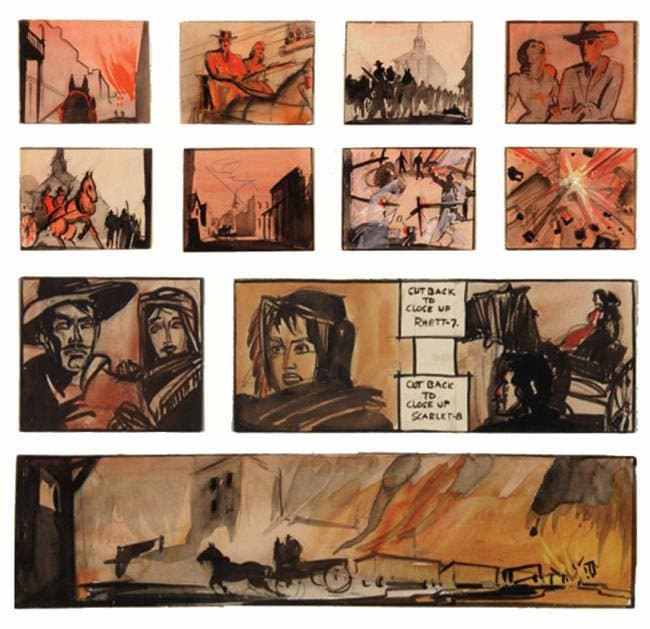 Gone With The Wind Storyboard
Most storyboards will follow typical conventions, these will consist of Detailed drawings to make mise-en-scene and onscreen action obvious, Writing that describes both onscreen action for actors to grasp a real idea of what they should be doing. And/Or writing that instructs the camera crew with information on what they need to do. The storyboard will also present other information to us, like shot length (Time), certain sounds (Diegetic or Non-Diegetic), Shot number to make it easier to follow the storyboard and any edits (transitions, etc). These are all in the hopes to make the production process more efficient fro all crew and cast members.
Film
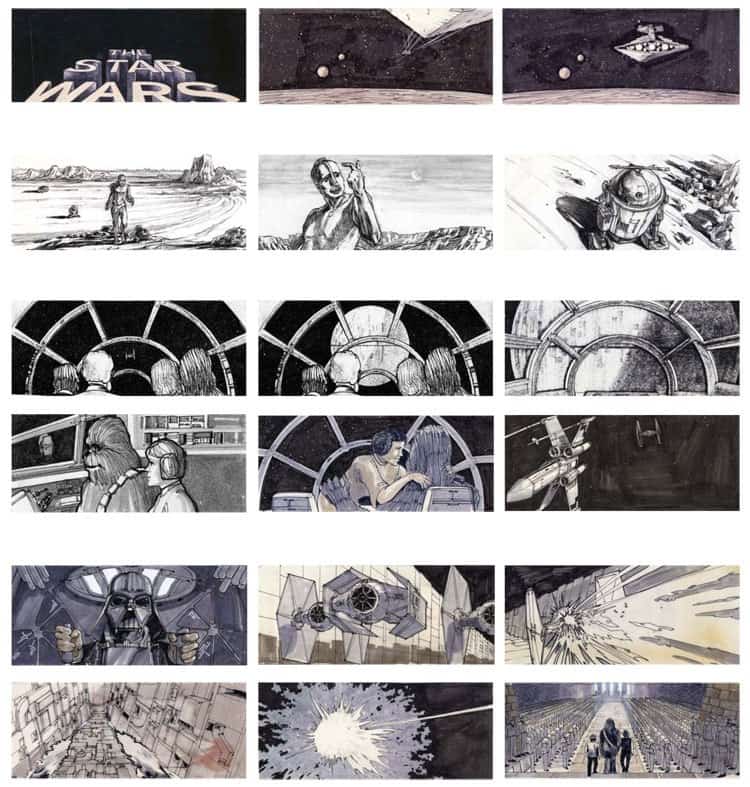
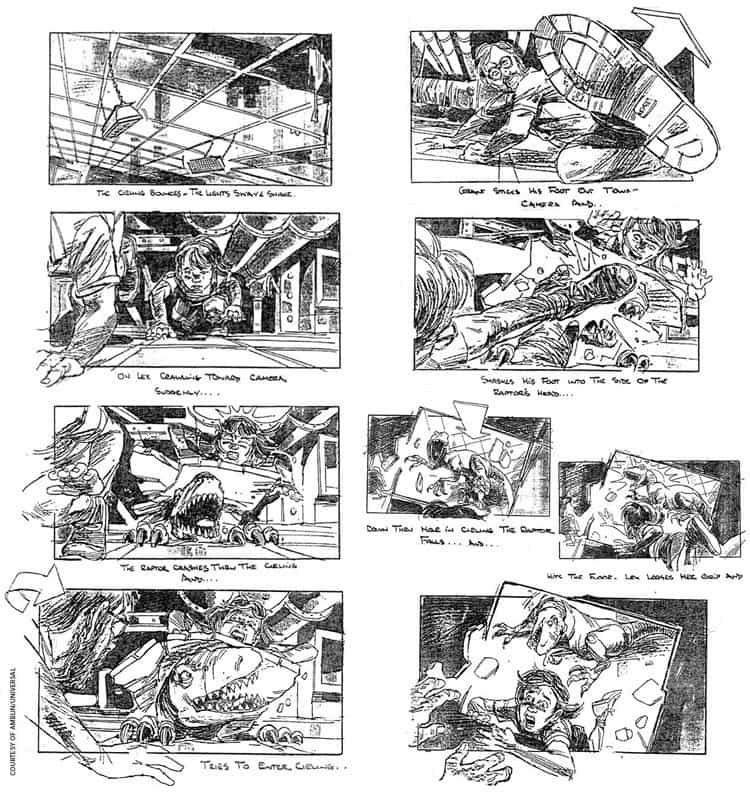
The left storyboard is from Star Wars: A New Hope (1977), and
the right storyboard is from Jurassic Park (1993). Both storyboards have very
detailed drawings which obviously makes it easier for the cinematographer and
camera crew to know what details to focus on in each shot. The Star wars
storyboard covers the entire film in 24 frames, whereas the Jurassic park
storyboard covers one scene in 9 shots. So clearly the Jurassic park one was
more detailed for the films entirety, this would’ve been more helpful for the
cinematographers and camera crew as they’d have much more to follow and know
more meticulous details in terms of camera movements and on set details.
The Jurassic Park storyboard also has writing under the slides which adds for more detail and understanding. The writing in this example explains what is happening in each slide/shot making it easier for cinematographers, the director and actors to understand. Also the use of arrows in some of the slides tells the actors where to move, for example in the top right slide, the arrow is essentially telling the actor to kick in that direction of the arrow, again, this is an example of how storyboards make the shooting process more efficient. However, this storyboard could use colour to make the scenes easier to set up in terms of mise-en-scene and set design during the production phase. It could also help deter different objects from the other because it could get confusing having loads of different objects in black and/or white.
The Star wars storyboard is useful in the aspect that it sums up the plot very easily and quickly for George’s ease, and since he made the storyboards and directed the films he may not have needed to storyboard each scene in depth since he had the ideas in his head/written down and knew how he’d want them to look, The Jurassic park one however was made by David Lowery, yet the film was directed by Steven Spielberg, so even though Spielberg worked with Lowery, the storyboards were more in-depth because they weren’t made by the director himself, or perhaps Spielberg chose to have them made this way for his own, or other crew/cast members sakes. Yet again, the star wars storyboard could use some colour to help with landscape obviousness and just like Jurassic park, making the set design and mise-en-scene easier to replicate. For example, the shots of C-3PO in the open landscape could be accidentally confused for a snowy landscape, even though it's the deserts of Tatooine, likewise the shots in the millenium falcon have black surroundings to implement its space but more detail could make it more obvious just in case it's confused for the sky, perhaps stars could make this more obvious.
In conclusion film storyboards are useful for helping crew and cast members set up scenes and know how to film and act in them as to achieve a more professional and efficient shooting session, this is the same for the other media storyboards as setting setup and character design is very important, more so for the other media forms as those characters need to be artificially created, and not casted and filmed. They can cover a scene/s in huge depth or cover a large portion in little detail, but enough to sum up the story within that portion so the director doesn’t forget certain focal points of the film. Overall I’d say they’re useful as they make the filming process easier and more efficient.
The Jurassic Park storyboard also has writing under the slides which adds for more detail and understanding. The writing in this example explains what is happening in each slide/shot making it easier for cinematographers, the director and actors to understand. Also the use of arrows in some of the slides tells the actors where to move, for example in the top right slide, the arrow is essentially telling the actor to kick in that direction of the arrow, again, this is an example of how storyboards make the shooting process more efficient. However, this storyboard could use colour to make the scenes easier to set up in terms of mise-en-scene and set design during the production phase. It could also help deter different objects from the other because it could get confusing having loads of different objects in black and/or white.
The Star wars storyboard is useful in the aspect that it sums up the plot very easily and quickly for George’s ease, and since he made the storyboards and directed the films he may not have needed to storyboard each scene in depth since he had the ideas in his head/written down and knew how he’d want them to look, The Jurassic park one however was made by David Lowery, yet the film was directed by Steven Spielberg, so even though Spielberg worked with Lowery, the storyboards were more in-depth because they weren’t made by the director himself, or perhaps Spielberg chose to have them made this way for his own, or other crew/cast members sakes. Yet again, the star wars storyboard could use some colour to help with landscape obviousness and just like Jurassic park, making the set design and mise-en-scene easier to replicate. For example, the shots of C-3PO in the open landscape could be accidentally confused for a snowy landscape, even though it's the deserts of Tatooine, likewise the shots in the millenium falcon have black surroundings to implement its space but more detail could make it more obvious just in case it's confused for the sky, perhaps stars could make this more obvious.
In conclusion film storyboards are useful for helping crew and cast members set up scenes and know how to film and act in them as to achieve a more professional and efficient shooting session, this is the same for the other media storyboards as setting setup and character design is very important, more so for the other media forms as those characters need to be artificially created, and not casted and filmed. They can cover a scene/s in huge depth or cover a large portion in little detail, but enough to sum up the story within that portion so the director doesn’t forget certain focal points of the film. Overall I’d say they’re useful as they make the filming process easier and more efficient.
Animation
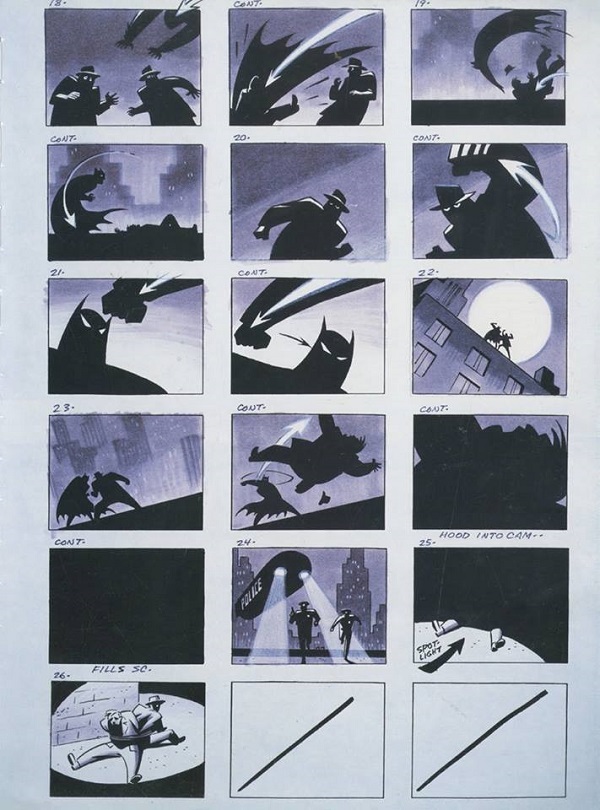
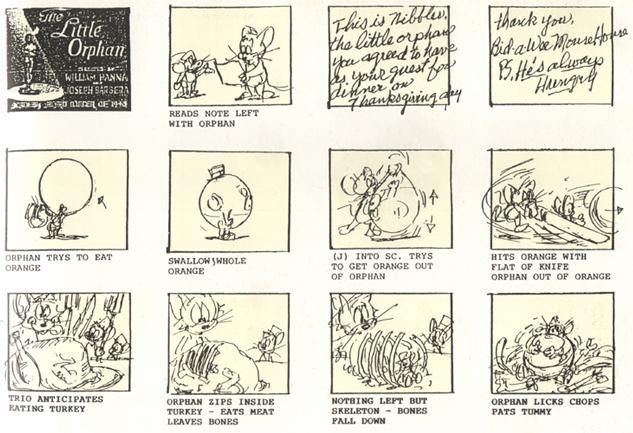
The left Storyboard is from Batman: The AnimatedSeries (1992 - 95), and the right storyboard is from Tom and Jerry (1940-67).
The Batman storyboard is visually obvious as to what’s happening in each shot,
and the use of arrows to show characters movement helps the animators when it
comes to making the final piece. There is also another arrow which is on slide
number 25 which is used to show the direction of the light from a spot light,
and also the movement as in shot 25 the criminals are invisible in the pitch
black but the light is directed to move over them so in shot 26 they’re
completely visible under the spotlight. Many of the slides have shot numbers
starting from 18 and ending in 26, this is because most slides are followed by
a slide labelled “Cont” which means continue from the previous shot, it’s
mostly used for shots with movements like punches and rolls, etc.The
colour scheme is also very similar to the final product, the differences are
that instead of a light blue sky, it’s orange, and the police blimps lights are
yellow.
As for the Tom and Jerry storyboard it’s more detailed like the Jurassic park one with writing to explain what’s happening in the scene making it easier for the animators to make the story more obvious for viewers. There is also a use of arrows, just like the Batman storyboard to indicate the movement of a character or object. The left most middle slide for instance has an arrow indicating that the orphan picks up the orange. Slides 3 and 4 also contain the contents of the letter that was left with the orphan, thus making it easier for the animators to know exactly what to write inside the letter without having to improvise or question it whilst in the production phase. It can also help those animators get a better understanding of the character (Specifically the orphan) so they know how to structure their personality.
In conclusion, animation storyboards have lots of freedom, the fact they can be drawn in the art style that’ll be used in the final product makes it easy for animators to understand and thus transform from a storyboard to the final piece. This is unlike live action film storyboards, and somewhat like video game storyboards, as with live action, certain actions you'd expect to see in animated works are unachievable, for reasons as simple as our limbs cannot do what they do in video games and they're very surreal. The use of arrows is also very prevalent in both works, and likely more so that actions are more obvious for animators, this is necessary since animations aren’t always realistic and can include outrageous feats, so having arrows helps the people animating know what they’re doing with certain characters and actions, like I said this isn't necessarily as necessary in film/live action storyboards as the characters can only do what humanly possible. Also some storyboards have descriptive writing to help make the scenes more obvious so the animation can be seamless and not clueless between the shots shown in the storyboard.
As for the Tom and Jerry storyboard it’s more detailed like the Jurassic park one with writing to explain what’s happening in the scene making it easier for the animators to make the story more obvious for viewers. There is also a use of arrows, just like the Batman storyboard to indicate the movement of a character or object. The left most middle slide for instance has an arrow indicating that the orphan picks up the orange. Slides 3 and 4 also contain the contents of the letter that was left with the orphan, thus making it easier for the animators to know exactly what to write inside the letter without having to improvise or question it whilst in the production phase. It can also help those animators get a better understanding of the character (Specifically the orphan) so they know how to structure their personality.
In conclusion, animation storyboards have lots of freedom, the fact they can be drawn in the art style that’ll be used in the final product makes it easy for animators to understand and thus transform from a storyboard to the final piece. This is unlike live action film storyboards, and somewhat like video game storyboards, as with live action, certain actions you'd expect to see in animated works are unachievable, for reasons as simple as our limbs cannot do what they do in video games and they're very surreal. The use of arrows is also very prevalent in both works, and likely more so that actions are more obvious for animators, this is necessary since animations aren’t always realistic and can include outrageous feats, so having arrows helps the people animating know what they’re doing with certain characters and actions, like I said this isn't necessarily as necessary in film/live action storyboards as the characters can only do what humanly possible. Also some storyboards have descriptive writing to help make the scenes more obvious so the animation can be seamless and not clueless between the shots shown in the storyboard.
Video Game
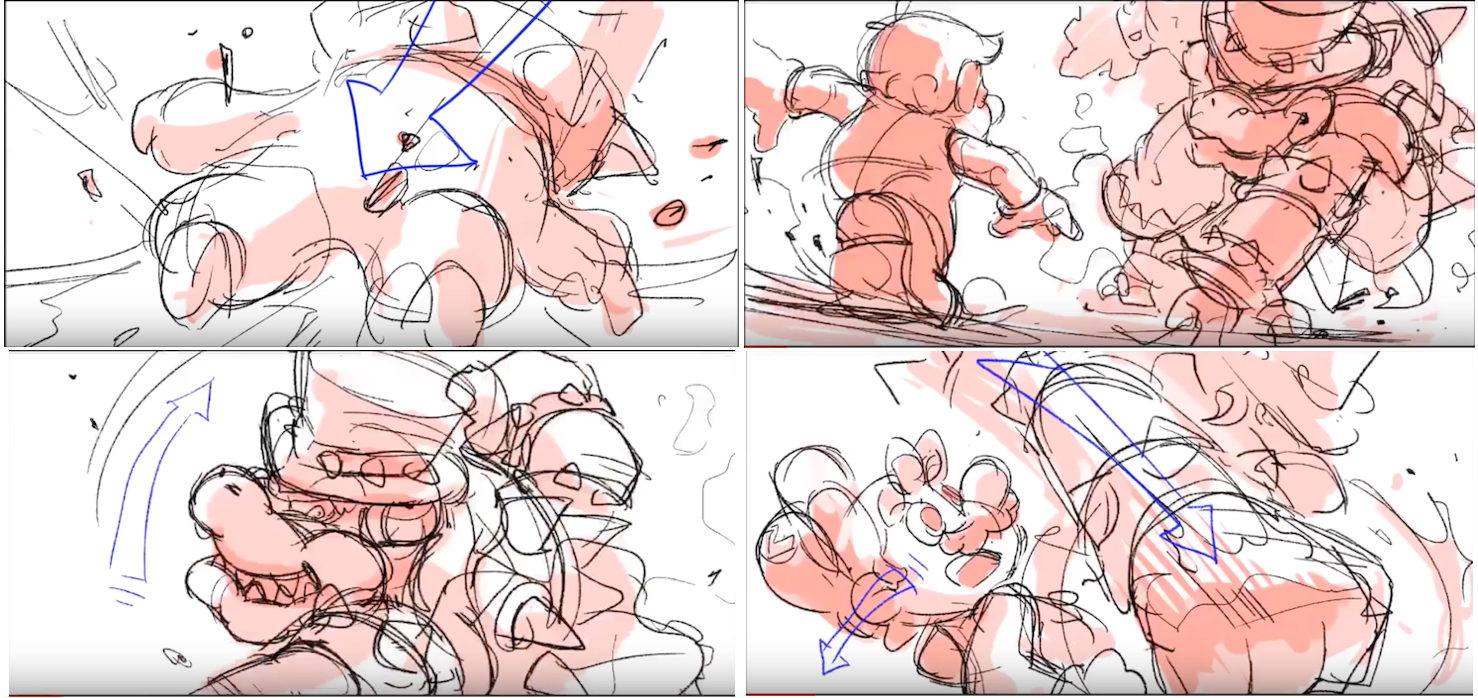

The left storyboard is from Super Mario Odyssey (2017), the purpose of it is for a video game cut scene and the right storyboard is a character design of Handsome Jack from Borderlands (2009). Whilst both are clearly different in the aspect that one is used by animators to make a cut scene, and the other is used by the character design team to make the character in the game. With the Super Mario storyboard there are, yet again, arrows that indicate the characters movement which helps the animators know exactly what is happening and how to animate the particular actions. The drawing is clear, thus it's easy for animators to transfer these drawings to actual characters in the final product. The fact these are also well known characters in the video game industry means there doesn't need to be a huge amount of detail, that's perhaps why there is no real use of colour, as the animators can look at previous pieces of work of these characters and use those same colours. However, there is no background in these shots, the only visible thing is the action (The characters fight), so enquiries would have to be made about the particular background and mise-en-scene since the characters can't be the only thing on screen in the final product. The different camera angles and shots are also presented to us by the drawing itself, for instance the 1st slides clearly supposed to be a close up of Bowser's hand instead of a long shot, or the drawing would be in long-shot format.
As for the Handsome Jack storyboard, its 1 slide, that's used to detail the characters appearance and give a bit of information about the characters facial details. This doesn't have the same use as the average storyboard, so the use of timing, edits, camera movements and transitions aren't necessary. Despite this, technically camera angles are taken into account, this is clearly shown through the many drawings of his face from different angles, for instance we see his face front on, slightly looking to the side, and a profile shot, this is done to help animators design his face as detailed and effectively as possible when he's facing in any direction. Also sound directions could be taken into account, the writing in this image may just describe his facial features, but character design sheets could include details about sound, most obviously the way they talk, but also little details like, if the character isn't quite human they may have some strange noises, whether that be their breathing, or maybe if their skin squelches as they walk if they're some kind of mythical monster, much like the Bog Beast from World Of Warcraft.
In conclusion, video game storyboards can vary more so than films and animations, and other storyboards, this is because they can include cut scene storyboards, game play storyboards, or character design sheets, this is a much wider variety than other forms of media can have, it's because with video game storyboards people will have to turn the characters and settings into actual explorable pieces so more detail is necessary as opposed to other live action pieces as the settings, unless made, are already existing, and characters will just be actors, costumes though have to be detailed and clear in the storyboards.. Both storyboards have little detail in ways of writing unlike the other storyboards, for the most part. The purpose of these storyboards is to help the animators turn the characters and scenes into visual pieces within the game. Like other storyboards, they typically have to follow most codes and conventions, for instance they'll have arrows to indicate movement from both characters and camera, they'll have detailed drawings that make mise-en-scene and action obvious. These are used very often in the other types of storyboard.
My Animatic
https://www.youtube.com/watch?v=7c-E2lCGib4&feature=youtu.be
The left storyboard is from Super Mario Odyssey (2017), the purpose of it is for a video game cut scene and the right storyboard is a character design of Handsome Jack from Borderlands (2009). Whilst both are clearly different in the aspect that one is used by animators to make a cut scene, and the other is used by the character design team to make the character in the game. With the Super Mario storyboard there are, yet again, arrows that indicate the characters movement which helps the animators know exactly what is happening and how to animate the particular actions. The drawing is clear, thus it's easy for animators to transfer these drawings to actual characters in the final product. The fact these are also well known characters in the video game industry means there doesn't need to be a huge amount of detail, that's perhaps why there is no real use of colour, as the animators can look at previous pieces of work of these characters and use those same colours. However, there is no background in these shots, the only visible thing is the action (The characters fight), so enquiries would have to be made about the particular background and mise-en-scene since the characters can't be the only thing on screen in the final product. The different camera angles and shots are also presented to us by the drawing itself, for instance the 1st slides clearly supposed to be a close up of Bowser's hand instead of a long shot, or the drawing would be in long-shot format.
As for the Handsome Jack storyboard, its 1 slide, that's used to detail the characters appearance and give a bit of information about the characters facial details. This doesn't have the same use as the average storyboard, so the use of timing, edits, camera movements and transitions aren't necessary. Despite this, technically camera angles are taken into account, this is clearly shown through the many drawings of his face from different angles, for instance we see his face front on, slightly looking to the side, and a profile shot, this is done to help animators design his face as detailed and effectively as possible when he's facing in any direction. Also sound directions could be taken into account, the writing in this image may just describe his facial features, but character design sheets could include details about sound, most obviously the way they talk, but also little details like, if the character isn't quite human they may have some strange noises, whether that be their breathing, or maybe if their skin squelches as they walk if they're some kind of mythical monster, much like the Bog Beast from World Of Warcraft.
In conclusion, video game storyboards can vary more so than films and animations, and other storyboards, this is because they can include cut scene storyboards, game play storyboards, or character design sheets, this is a much wider variety than other forms of media can have, it's because with video game storyboards people will have to turn the characters and settings into actual explorable pieces so more detail is necessary as opposed to other live action pieces as the settings, unless made, are already existing, and characters will just be actors, costumes though have to be detailed and clear in the storyboards.. Both storyboards have little detail in ways of writing unlike the other storyboards, for the most part. The purpose of these storyboards is to help the animators turn the characters and scenes into visual pieces within the game. Like other storyboards, they typically have to follow most codes and conventions, for instance they'll have arrows to indicate movement from both characters and camera, they'll have detailed drawings that make mise-en-scene and action obvious. These are used very often in the other types of storyboard.
My Animatic
https://www.youtube.com/watch?v=7c-E2lCGib4&feature=youtu.be
Comments
Post a Comment